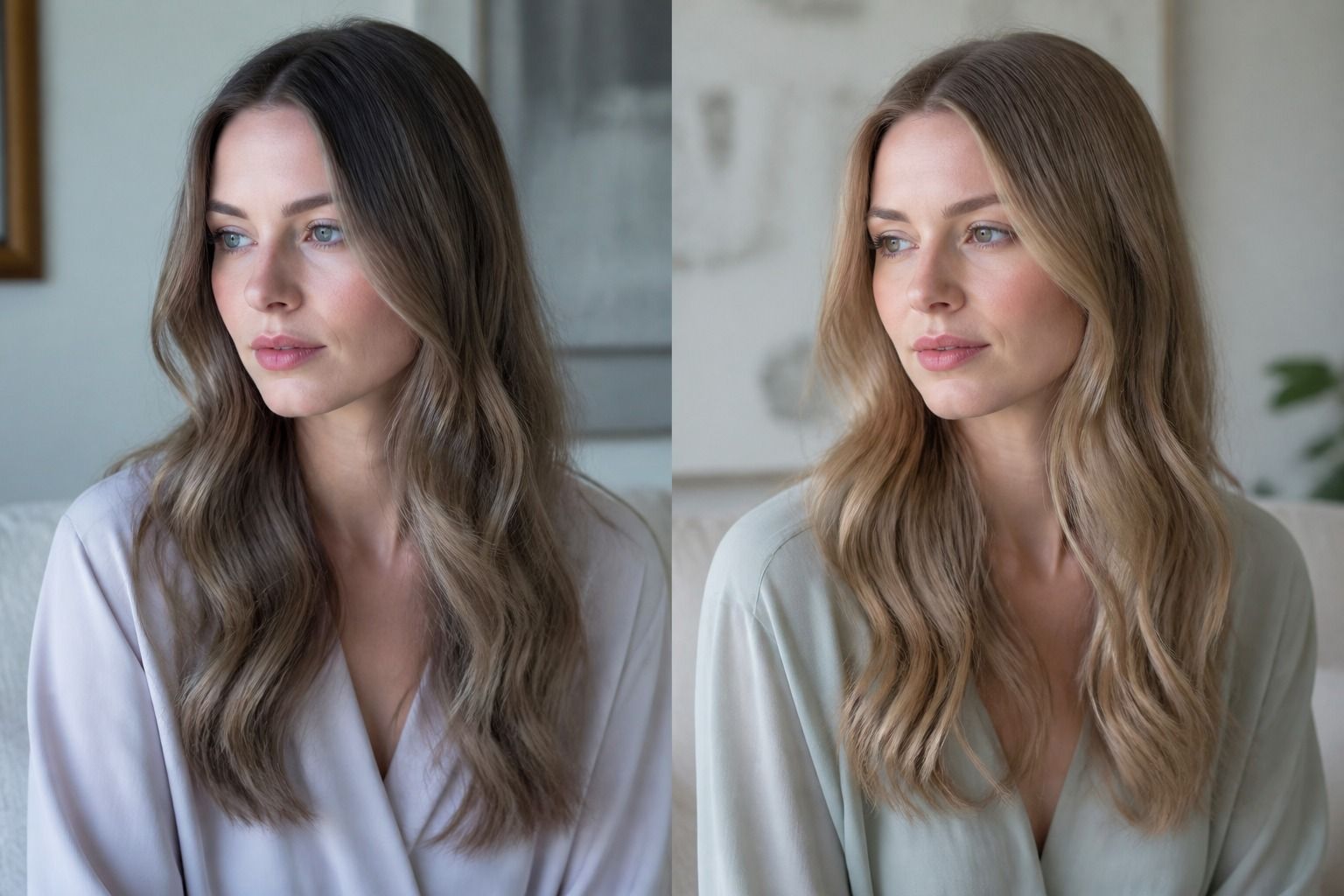
Cool Summer and Soft Summer hair colors overlap enough to confuse people, especially in edited photos. Both can include ash brown and beige blonde. The useful distinction is what leads the result: Cool Summer needs a clearer cool quality, while Soft Summer needs muted contrast and a gentler edge.
The two qualities people often mix up
The first useful question is whether coolness versus softness, then depth looks balanced when you compare two similar shades at the same depth and ask whether the face responds better to cleaner coolness or to a lower, quieter contrast. A shade can look perfect in a product image and still feel too bright, too gray, too warm, or too deep once it is next to the face. I would rather compare a small group of related options than search for one magical name.
Compare coolness, softness, and depth
A practical comparison needs a fixed starting point. Keep the light, camera distance, and clothing as consistent as possible, then change one variable at a time. If the base color, undertone, and contrast all change together, it becomes difficult to understand what you actually prefer.
Use softness as the anchor. Compare the option beside your natural features, then check it again when the light moves, the roots grow out, or the hair loses its fresh salon finish. That small reality check is often more revealing than a longer list of trend names. Keep the option if it remains comfortable in ordinary clothes and ordinary light; revise it if it asks your whole appearance to work around the hair.
| Direction | Examples | What to notice |
|---|---|---|
| Cool Summer | coolness leads | ash brown or cool beige with clearer temperature |
| Soft Summer | softness leads | mushroom, taupe, and smoky shades with muted contrast |
| Shared middle | both qualities are balanced | neutral bronde or softened ash can work as a bridge |
Hair colors that sit between both seasons
The details that matter most are easy to miss when the discussion stays at the level of shade names. Look at coolness, softness, chroma, medium depth, sun-faded lengths. They change the way color grows out, catches light, and sits beside the eyes, brows, and skin. The most wearable option is often the one that still looks intentional after the first freshness has gone.
The useful check here is chroma. Put the shade beside your natural features and notice how it behaves when the light moves, the roots grow out, or the hair loses its fresh salon finish. That small reality check is often more revealing than a longer list of trend names. Keep the option if it remains comfortable in ordinary clothes and ordinary light; revise it if it asks your whole appearance to work around the hair.
Why the same shade behaves differently on two people
There is also a maintenance decision hiding inside the visual decision. Ask how often the roots will show, whether the lengths need a toner, and whether the shade depends on a level of lightening your hair has never handled. A color that works for one weekend may be a poor everyday choice if it creates a correction cycle you do not want.
Look at medium depth in ordinary light, not only in the salon mirror. The comparison is stronger when you check the option beside your features before and after the roots grow out. That small reality check is often more revealing than a longer list of trend names. Keep the option if it remains comfortable in ordinary clothes and ordinary light; revise it if it asks your whole appearance to work around the hair.
A simple decision process before booking color
Reference photos help when they show the whole situation: root, mid-length, ends, texture, and ordinary lighting. A close-up with perfect shine is useful for inspiration, but it cannot tell you whether the same direction will blend with your starting point. Save one polished reference and one realistic reference before the appointment.
With sun-faded lengths in mind, step away from the close-up and judge the whole effect. A shade earns its place when it still works after the light changes and the fresh finish fades. That small reality check is often more revealing than a longer list of trend names. Keep the option if it remains comfortable in ordinary clothes and ordinary light; revise it if it asks your whole appearance to work around the hair.
Make the choice workable in real life
Before you commit, write down the starting color, the result you want, the maintenance you will accept, and the sign that would make you stop. This is more useful than arriving with a single shade word because it leaves room for the professional to choose a safer route. It also protects you from a common mistake: treating a reference photo as a promise instead of as evidence about direction, depth, and finish.
A good result should still make sense after the first wash, under a different lamp, and with your everyday wardrobe. If the color needs perfect lighting to look balanced, it is probably too extreme for the plan. If it looks quiet at first but keeps the eyes and skin clear, it may have more staying power than the most exciting screenshot. Choose the version you can repeat, maintain, and explain without regret.
Reference photos help when they show the whole situation: root, mid-length, ends, texture, and ordinary lighting. A close-up with perfect shine is useful for inspiration, but it cannot tell you whether the same direction will blend with your starting point. Save one polished reference and one realistic reference before the appointment.
Keep one final comparison in reserve: look at the shade next to your everyday hair texture, your usual neckline, and the amount of regrowth you are prepared to see. The choice should survive ordinary conditions rather than depend on a perfect pose or a freshly styled finish. If the direction still looks balanced after that check, it is ready for a calmer salon conversation.
Keep one final comparison in reserve: look at the shade next to your everyday hair texture, your usual neckline, and the amount of regrowth you are prepared to see. The choice should survive ordinary conditions rather than depend on a perfect pose or a freshly styled finish. If the direction still looks balanced after that check, it is ready for a calmer salon conversation.